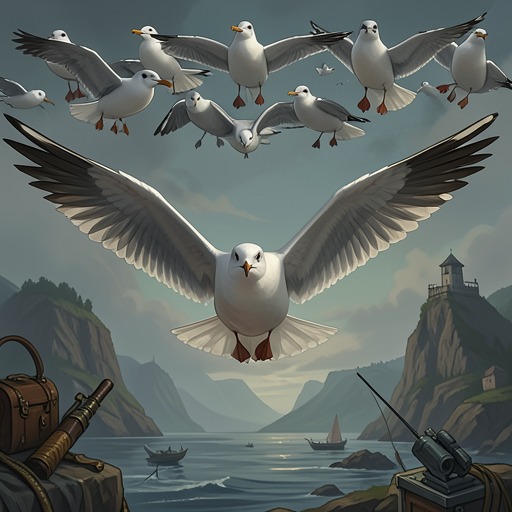
Relationship between Fletcher Lynd Seagull and Flock
Jonathan Livingston SeagullFletcher Lynd Seagull’s relationship with the Flock is shaped by a reversal: the community that unjustly casts him out becomes the community he chooses to forgive, return to, and teach. His change does not erase the Flock’s prohibition on an Outcast’s return or the crowd’s attempt to destroy him. Instead, Fletcher’s eventual leadership grows from learning to distinguish the violent group from the good he can recognize in its members.
Exclusion and Grievance
Fletcher is still young when the Flock makes him an Outcast. He regards his punishment as exceptionally harsh and unjust: a barrel-roll around the Elder Gull, performed for fun, has been enough to expel him. Flying, to Fletcher, means far more than moving from place to place, and he cannot understand how the other gulls fail to see the glory of learning to fly. His anger turns the Far Cliffs into the setting for a threatened counter-identity: he vows to be an outlaw and imagines making the Flock regret its decision.
That first response is not reconciliation. Fletcher is hurt, sees the Flock as blind to what he values, and is ready to fight it. Jonathan Livingston Seagull meets him in the air and asks him not to be harsh toward the gulls who cast him out. Jonathan frames the expulsion as harm the Flock has done to itself, and urges Fletcher to forgive the flock and help it understand what he sees. The appeal asks him to turn the very experience that fuels his resentment into a reason to return.
Fletcher accepts that demand as part of wanting to fly. Jonathan asks whether he wants flight enough to forgive the Flock, learn, and one day go back to help its members understand. Fletcher answers softly that he does. Forgiveness here is not an already completed feeling or a withdrawal of his grievance; it is a commitment tied to practice and to a future return.
Return Against the Law
A month after Jonathan’s students begin their training, Jonathan says it is time to return to the Flock. The students object that they are not welcome: they are Outcasts, and cannot force themselves into a place that rejects them. Jonathan answers that they are free to go where they wish and be what they are, then takes off east toward the Flock’s home grounds.
The decision puts Fletcher between the group’s stated law and the teacher he has chosen to follow. The Law of the Flock forbids an Outcast to return, and it has gone unbroken for ten thousand years. Jonathan is already a mile across the water while the others are still hesitating; if they delay, he will meet the hostile Flock alone. Fletcher points out that, since they are no longer part of the Flock, they need not obey its law, and that they could be more useful there if a fight begins. He follows not because the community has welcomed him back, but because he decides its prohibition cannot settle where he is free to go.
The return is made as a conspicuous display of skill. Eight birds arrive from the west in double-diamond formation, wingtips almost overlapping, at 135 miles per hour. Jonathan leads, Fletcher flies smoothly at his right wing, and Henry Calvin struggles gamely at the left. Over Council Beach, the formation rolls together from level to inverted and back; each gull then pulls into a full loop before landing dead slow on the sand. The performance sharply interrupts the ordinary sounds of the Flock, and eight thousand gulls watch.
Jonathan begins critiquing the flight as if the group had simply come to practice. That calm, practical response contrasts with the shock of the audience: the returning birds are recognized as Outcasts, yet their mastery also prompts younger gulls to wonder how they learned to fly that way. The return therefore makes the contradiction visible. The Flock’s rule says these birds must remain outside, while their arrival demonstrates what learning beyond the Flock’s customary limits can achieve.
The Elder’s Word soon restores the boundary through a broader act of social exclusion. The Flock is told to ignore the Outcasts: speaking to one makes a gull an Outcast, and even looking at one breaks the Law of the Flock. Gray-feathered backs turn toward Jonathan, who proceeds with practice sessions above Council Beach. Fletcher’s return has not immediately reconciled him with the community; it places him again within sight of it, under the same prohibition that first drove him away.
The Mob and the Possibility of Return
Fletcher’s connection to the Flock becomes more dangerous when he crashes into a cliff and is believed dead. He opens his eyes at the cliff’s base in the middle of the assembled Flock, and his movement sets off cries that he lives and has been brought back to life. The crowd’s interpretations divide between wonder and fear: some call Jonathan the Son of the Great Gull, while another voice calls him a devil who has come to break the Flock.
There are four thousand gulls in the crowd. Their alarm turns into a mob: eyes glazed and beaks sharp, they close in to destroy. The scene brings Fletcher’s exclusion into immediate physical danger. The Flock that had ordered its members not even to look at Outcasts now gathers around Fletcher’s apparent return from death, but the attention is not welcome recognition; it becomes a threat to both teacher and student.
Jonathan asks Fletcher whether he would feel better if they left. Fletcher does not object, and the two escape the crowd. The next morning, the Flock has forgotten its madness, but Fletcher has not. His memory of the attempted killing persists after the crowd’s fury has passed, making his later question to Jonathan a pointed test: he wants to understand how anyone can love birds who have just tried to kill him.
Forgiveness as a Continuing Relation
Jonathan’s answer gives Fletcher a different way to understand his relationship with the Flock. Love is not love for hatred or evil, he explains; it requires practice in seeing the real gull, the good in each member, and helping them recognize that goodness in themselves. The teaching does not deny the mob’s actions. It directs Fletcher to look beyond those actions without pretending they did not happen.
Jonathan recalls Fletcher’s own earlier condition: newly made an Outcast, ready to fight the Flock to the death, and beginning to build a bitter hell for himself on the Far Cliffs. Now Fletcher is building his own heaven instead and leading the whole Flock in that direction. The contrast measures his change not by whether his expulsion has been rescinded, but by what he does with the wound it left. The former target of the rule becomes a guide toward a different communal life.
The change also leads toward succession. Fletcher is frightened when Jonathan implies that he will leave and that Fletcher must lead. Later, after Jonathan vanishes, Fletcher drags himself into the sky and faces a brand-new group of students. He begins by repeating Jonathan’s teaching about the gull as an unlimited idea of freedom, then recognizes that the students are not yet ready for that account and starts instead with level flight. For a moment he sees them as they really are and loves what he sees. His race to learn begins again, now joined to teaching.
Fletcher’s relationship with the Flock consequently ends neither in simple restoration nor in permanent separation. The evidence does not show the Flock formally changing its law or apologizing for its violence. It shows Fletcher returning despite the law, surviving the mob, remembering what happened, and choosing to help the gulls rather than make them suffer in return. His succession to Jonathan makes that choice practical: he is no longer only the young Outcast seeking to prove the Flock wrong, but a teacher who can recognize possibility in the very community that rejected him.